In June 2025, CULTIVATE published its first six EIP-AGRI Practice Abstracts, each turning a project result into a short, jargon-free summary that practitioners can quickly act on. As CULTIVATE enters its final stretch, the project now completes the picture with a second batch of six, available on Zenodo.
Where the first batch showcased individual initiatives and results, this second set gathers the instruments CULTIVATE built to support food sharing at every stage – from getting communities involved and finding the right resources, to weighing costs and benefits, learning from peers, navigating governance and estimating impact at city scale. The common thread is that no single instrument does the job on its own: an engagement format, an orientation platform, a governance repository, a cost–benefit calculator, a peer-learning model and an impact methodology each tackle a different obstacle, and work best in combination.
Here’s an overview of the six abstracts now available:
1. Lab & Kitchen: a place at the table for everyone
Developed by CASCOLAND, Lab & Kitchen is a citizen engagement format that uses social design and shared cooking to bring residents, municipal actors, researchers, artists and professionals around the same table. It surfaces local knowledge that has been marginalised and builds community capacity to reshape food production and distribution along more socially and ecologically sustainable lines. Each edition is co-designed on site through rapid prototyping — outputs may include community cookbooks, foraging maps, food sharing cabinets or community ovens — and culminates in a public celebration and feast. Staged in Utrecht, Freiburg, Athens and Lisbon, it offers a replicable, place-specific model for inclusive participation. A How-to Guide and supporting materials are available through the Library of Citizen Engagement.
Download the PDF here
2. Food Sharing Compass: helping stakeholders find and scale food sharing solutions
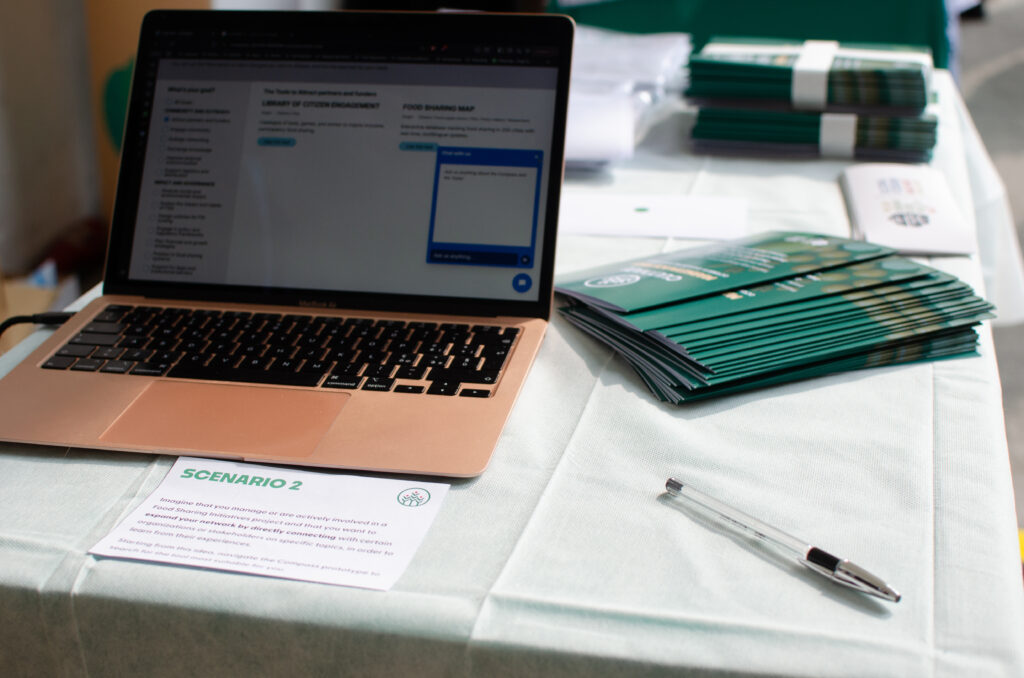
The Food Sharing Compass is an online navigation platform that helps users find their way through a fragmented food sharing landscape. Rather than a static repository, it works as an orientation tool: users start from a specific challenge or objective — assessing impacts, strengthening governance, engaging communities, identifying collaboration opportunities or exploring practices — and are guided towards the most relevant resources. It brings together five CULTIVATE tools (the Food Sharing Map, the Menu of Good Governance, the Food Sharing Calculator, the Community of Practice and the Library of Citizen Engagement) in a single entry point, supported by user-centred design and an integrated AI chatbot. Shaped by a stakeholder survey and three rounds of user testing, it simplifies access to knowledge and supports the replication and scaling of successful solutions.
Download the PDF here
3. Food Sharing Community of Practice: a step-by-step model for peer learning and scaling
Many food sharing organisations work in isolation, with few chances to exchange practical knowledge with peers. CULTIVATE developed and tested a Food Sharing Community of Practice (CoP) built on a five-step model: thematic webinars, peer-to-peer “Buddy Visits”, bootcamps and action plans, coaching and network expansion, and a digital collaboration platform on the Sustainable Food Systems Network. The benefits include stronger networks, less duplication of effort, faster problem-solving, greater innovation capacity and more confidence in engaging with policymakers and funders — at relatively low cost. The model was tested with initiatives across nine countries. The CULTIVATE Food Sharing Community of Practice Handbook is available on Zenodo.
Download the PDF here
4. Food Sharing Calculator: identifying the costs and benefits of food sharing
The Food Sharing Calculator is an online tool for FSIs, funders and citizens to identify costs and benefits, measure impact and guide investment. Users select their food sharing activity and work through a questionnaire covering facilities, vehicles, equipment, food-related costs, utilities, volunteer support, outreach, staff, training and services; they can include volunteer time and donated resources, estimate cost ranges and download a tailored PDF report. On the benefits side, they explore the social, environmental and economic value created by different activities, drawing on examples from European cities. Looking at costs and benefits together supports planning, reporting, funding applications and better decisions about how to establish, maintain or scale initiatives.
Download the PDF here
5. Menu of Good Governance: actionable solutions to overcome governance barriers
Food sharing initiatives often struggle with regulatory barriers, limited resources and weak coordination between stakeholders. The Menu of Good Governance (MGG) is an online decision-support tool and curated repository of more than 300 governance practices from across Europe, organised into four areas: structural factors, regulatory frameworks, resources and knowledge, and participation and networks. Entries can be filtered by city size, type of solution, stakeholder type, level of intervention, type of initiative and region, so practitioners can surface targeted solutions and concrete inspiration for decision-makers at every level. Instructional videos help users find actionable advice quickly. The MGG is one of the tools of the Food Sharing Compass.
Download the PDF here
6. A methodology for estimating food sharing impacts for municipalities
Municipalities are often unaware of the sustainability impacts created by food sharing initiatives at the urban scale. This abstract sets out an approach that combines two Compass tools — the Food Sharing Map and the Sustainability Impact Assessment (SIA) element of the Food Sharing Calculator — to produce urban-scale SIA reports for policymakers. Municipalities can use the results to identify gaps in provision in areas of need or to develop support for existing initiatives. The approach has been trialled and refined in Barcelona, Utrecht, Milan, Brno, Freiburg, Lisbon, Athens, Brighton & Hove and Dublin, with 205 municipalities mapped. Cities already covered by the map can commission a report from CULTIVATE’s Sharing Solutions team; others can commission a mapping and SIA reporting service. A briefing note for policymakers is available on Zenodo.
Download the PDF here
All six abstracts are available on Zenodo.
Follow along on CULTIVATE social media channels and help spread the word using #CultivateSeeds.
Photo credits: ICLEI